
What the examiner will find, you find first.
Clearance surfaces every real conflict before it surfaces somewhere worse. Mark Watch keeps surfacing them every day after, on the same engine. TradeScreen is built to get both right.
Two jobs. One engine.
Both run on the same matching engine, so a new filing Watch flags is scored exactly the way a clearance search would score it. The same rigor applies point in time and ongoing.
Point in time.
Run the full matching stack before you file or advise, and capture the exact register state behind your opinion.
Continuous.
The same engine runs daily against new USPTO filings, scoring conflicts against the marks you protect.
We surface the conflicts. You supply the judgment.
No LLM decides what enters or leaves your conflict landscape. Retrieval is deterministic and auditable. If a mark is a candidate conflict, you see it.
We are obsessive about accuracy.
A clearance tool has two jobs. Keep the data faithful to the USPTO, and surface every real conflict that's in it. If either fails, nothing else about the tool matters.
When the search is right, the opinion you write on top of it is defensible.
When the opinion is defensible, your client is protected.
When your client is protected, your practice grows.
We surface the conflicts. You supply the judgment.
Variants you'd miss. Surfaced.
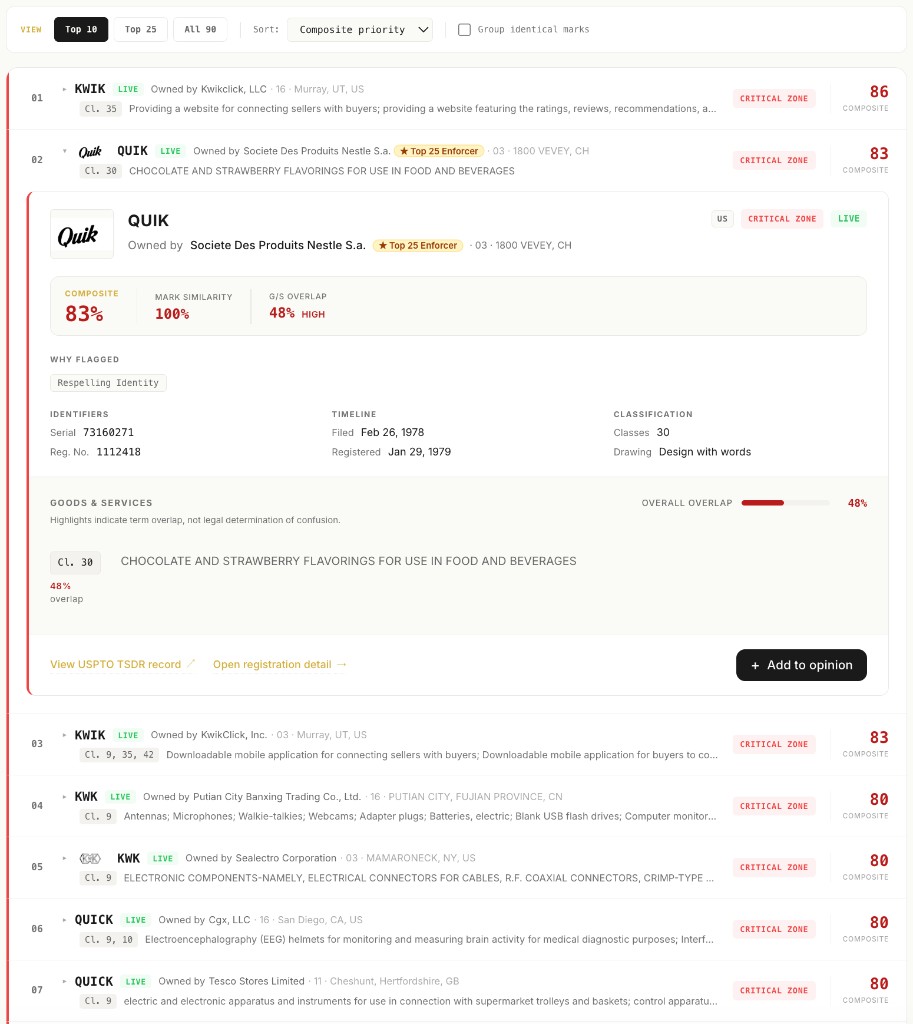
Every search runs the full matching stack. Phonetic equivalents, respellings, and visual variants surface alongside identical matches, scored by composite risk and ready to triage.
—Nineteen matching strategies, every search
Exact, phonetic, semantic, fuzzy, transposition, substring, reversal, and cross-class similarity all run on every candidate. No "basic" or "comprehensive" toggles that can be set wrong.
—USPTO data, faithful and current
Every record is pulled directly from the USPTO register and refreshed daily. The ingestion pipeline is monitored continuously and tested against the source of truth. No stale indexes, no republishers, no interpretive layer.
—The full US register, plus common law signals
Every federal record on file, refreshed daily, with market-use signals beyond the register surfaced alongside. Built for US clearance and focused on doing it completely.
—Reproducible by timestamp
Every search captures the exact USPTO register state at the moment it ran. If questioned months later, you can show not just what you found but what was on file when you found it.
Watch every mark you protect.
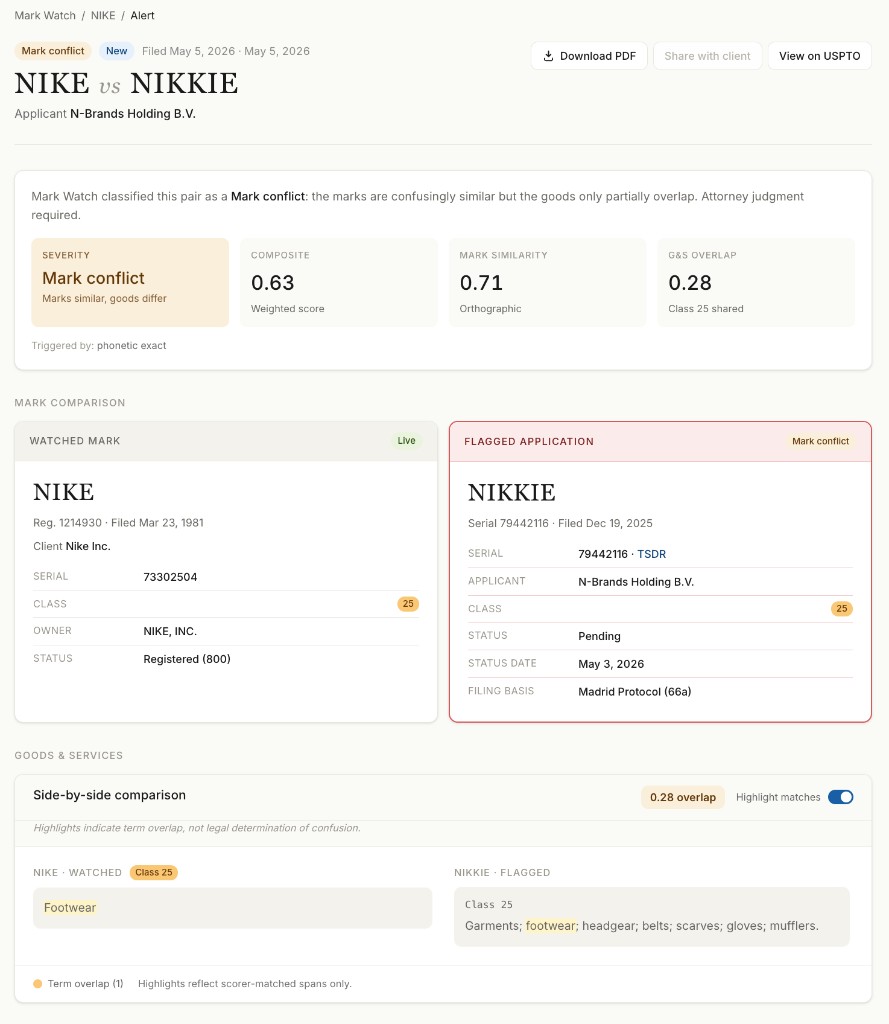
Daily monitoring of new USPTO filings against the marks you protect, using the same engine that powers clearance. Conflicts scored by composite risk, ready for triage when you sit down to your inbox.
—Daily against new USPTO filings
Every new application is evaluated against the marks you protect within a day of hitting the register. Conflicts are ready for triage when you sit down to your inbox.
—Scored on the same composite risk
Watch runs the identical matching engine as clearance. A new filing is judged by the same standard your clearance search applied, so monitoring is never the weaker pass.
—One alert per filing
When a single filing matches multiple registrations in a family, you get one grouped alert, not a flooded inbox.
—Traceable to the source record
Every alert shows why it fired and links to the underlying USPTO record. Nothing is asserted without a citation you can check.
Dial in what gets surfaced, and what doesn't.
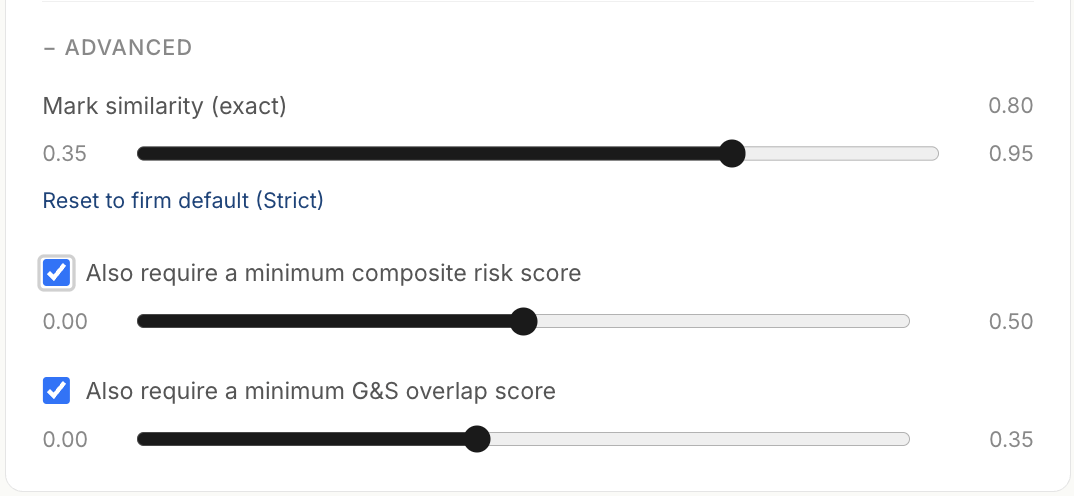
A single letter or a weak, common element will match new filings endlessly, and no attorney wants to wade through that. Sensitivity controls set the thresholds for what reaches your alert queue: tighten similarity on the brands you guard closely, raise the floor on the ones that would otherwise flood it, and require a minimum composite risk or G&S overlap before anything fires.
Unlimited users at every plan.
Per-seat pricing punishes firms for delegating work the way it should actually get delegated. TradeScreen charges for practice volume, not headcount.
Paralegals run knockouts. Associates evaluate findings. The partner signs the opinion. Everyone works in the same matter, nobody gets locked out because you ran out of seats.
Built to the standard a clearance opinion demands.
TradeScreen is built at the intersection of trademark practice and software engineering. Every decision about what the tool surfaces, and how, is made by people who understand what a defensible clearance opinion requires, not by one discipline guessing at the other.
The product exists because the standard clearance workflow was overdue for a rebuild. A hundred-page PDF report that costs four figures and takes days is slow, hard to audit, and priced like a relic. Clearance should be faster, fully traceable to the register, and defensible months after you ran it.
That standard governs everything: faithful USPTO data, deterministic retrieval, and a search you can reproduce by timestamp.
Built for the teams who own the opinion.
TradeScreen is used by boutique IP firms, private-practice trademark attorneys, and in-house trademark teams who run clearance and monitoring themselves. These are practitioners who sign the opinion and want a tool built to that standard, not a republished index sold at a markup.
In-house teams use TradeScreen to monitor portfolios of 180+ marks across multiple operating groups.
Boutique IP firms
Run knockouts, evaluate findings, and document the register state behind every opinion, all inside one matter.
Solo and private-practice attorneys
Full clearance and daily monitoring without enterprise tooling priced for enterprises.
In-house trademark teams
Monitor brand portfolios across operating groups, organized by business unit and brand.
Setup is self-serve and you're working live the same day, with direct access to the people building the product. Contact sales to see whether TradeScreen fits your practice.
From clearance to docket, one system.
Clearance
Run the full matching stack before you file or advise, with the exact register state captured behind every opinion.
Mark Watch
Daily monitoring against new USPTO filings, scored on the same engine.
Docketing
Track filing and response deadlines and matter status alongside your clearance and monitoring work, so the whole file lives in one place.
Frequently asked.
Pricing is based on practice volume, not per seat, with Mark Watch billed per monitored mark. Contact sales for a quote tailored to your portfolio.
Get in touch.
Tell us about your practice and we'll show you how TradeScreen fits your clearance and monitoring workflow.
The trademark tool your practice deserves.
Reliable. Rigorous. Clearance and monitoring on one engine, built to the standard a defensible opinion demands.
Contact sales →